



Lebanese powerlifter Julie Azzi recounts her journey from her first 90 kg squat to setting an Asian record at the World Championships, overcoming physical exhaustion, societal criticism and a demanding eight-month weight-cutting challenge.
The Lebanese powerlifter who refused to be told no
The Lebanese powerlifter who refused to be told no
By Jenna Geagea | November 18, 2026

Reading time: 4 min
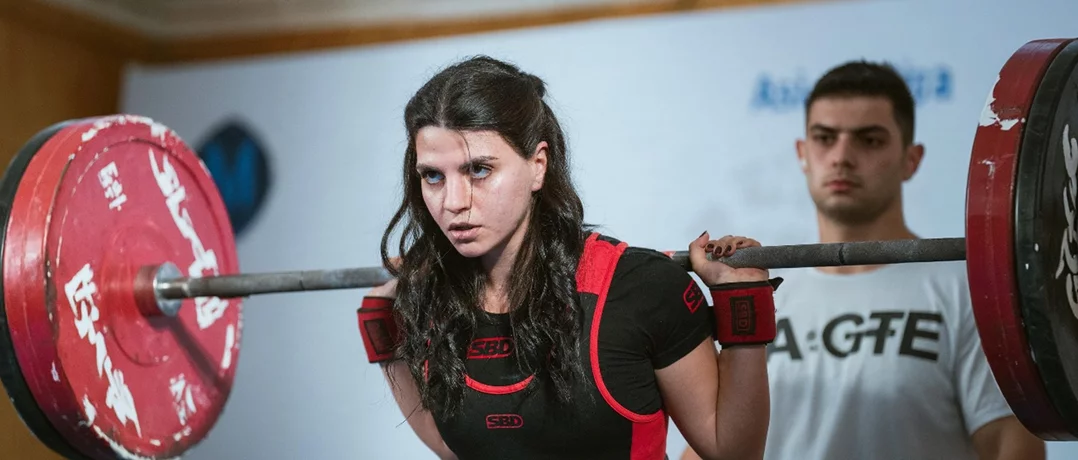
It began as an ordinary session, one of countless afternoons at a gym where nothing suggested history was about to be made. Her coach, who also owned the gym, proposed squats. Julie Azzi obliged. She lifted 90 kilos on her very first attempt
"He looked at me, and I looked at him," she told The Beiruter. The coach sensed something unusual and delivered a verdict that would shape the next four years, "you can do it now."
The year was 2022. Azzi was 18. Strength, she discovered, was not a hobby to be dabbled in but a calling to be pursued. She immersed herself in powerlifting content on Instagram, absorbed everything she could, and soon found herself standing at the platform of her first competition, which she won.
Victory proved intoxicating. "When you enter a powerlifting competition, something inside you comes alive," she reflected. The hunger to train harder, lift heavier and enter the next event takes hold quickly. "Once you've had a taste of it, you get hooked. There is always room to grow."
Her ascent was swift. National competitions followed, then the Arab Championships, hosted in Lebanon. Last year she crossed into the international arena at the Asian Championships, held in December, where she competed in the 63 kg category and posted a total of 427.5 kg, a record.
The summit, however, still lay ahead. The World Championships, powerlifting's grandest stage, were set for August, and Azzi set her sights on them. There was a catch, she would have to drop into the 57 kg category.
Eight months, ten kilos
Preparation began on January 1, mere weeks after the Asian Championships. The arithmetic was unforgiving. Almost 10 kilos had to disappear in eight months, and, as Azzi explained, the process cannot be rushed in her sport. Losing weight too quickly erodes strength, so the reduction was gradual, calculated and relentless.
"I had to watch my diet very carefully, never cheat on it, and train every day," she recalled. Her program ran five days a week, with each session consuming three hours depending on intensity. Rest days were rest in name only, as her active recovery regimen demanded 15,000 steps daily.
Then there was the matter of her livelihood. Azzi held a nine-to-five job as a content creator, a desk-bound role that left her stationary for hours. She compensated by logging her steps at the gym, where she ended up spending hours.". "I would spend almost five hours at the gym," she recalled.
The sacrifice yielded results. At the World Championships in August, Azzi squatted 165 kg, an Asian squat record in the 57 kg category. "This was the hardest journey of my life," she reflected, "but we made it." She has since traded the desk for the coaching floor.
The cost of conviction
Behind the records lies a toll she refused to disguise. The exhaustion was both physical and mental. "You reach a point where you are mentally and physically drained. All you want to do is sit in your bed and cry."
Often, that is precisely what happened. "I would literally have to drag myself to the gym. Sometimes I would cry before going in to train, and I would cry again after finishing my workout." Meals had to be consumed whether appetite cooperated or not, each one a calculated step toward the right weight on competition day. "Everything becomes challenging," she reflected, "and it was not my main job."
In 2022, the first resistance came from voices insisting that this was no pursuit for a girl. Azzi saw those reactions as a reflection of how conservative society can be.. Her response was simple persistence. "Eventually, once people realized that there was no way anyone could convince me to give up the sport, that obstacle disappeared."
The sharpest criticism arrived online. "If you are a female powerlifter and you post about it on social media, you are going to receive hate no matter what." Closer to home, some older acquaintances voiced doubts, fretting that the sport was not worth it and raising concerns about her family life and her back. Her family, though, came to understand that such fears were unfounded. "It is normal; it is part of the journey," she said of the online criticism.
For now, the competition calendar is clear. Azzi and her team have embarked on a long off-season, with no event on the horizon. The priority is consolidation, building strength at a new body weight and holding it. "Our goal now is to become stronger while maintaining a body weight of 56 kg," she explained.
A return to the platform is nonetheless in sight. The Asian Championships, roughly a year away, beckon. "God willing," she added. "So, we will see."
Azzi presented a profound message to every young girl who dreams of following her path but is paralyzed by fear. "There is nothing to be afraid of. Believe in yourself, and remember that everything people say from the outside is just noise."
She offered a final message, the one that carried her from a single set of squats to the world stage. "If you are lifting, you are doing it for yourself, not for anyone else. It is genuinely a sport that gives you an incredible level of confidence, both inside and outside the gym. It makes you feel like you can do anything."
-
-

-
Jenna GeageaReporter/Writer
-
