



Miziara’s story spans centuries of land struggles, political violence and emigration, with its ties to Nigeria shaping a village whose identity remains rooted in home and heritage.
Miziara, where emigration built a village

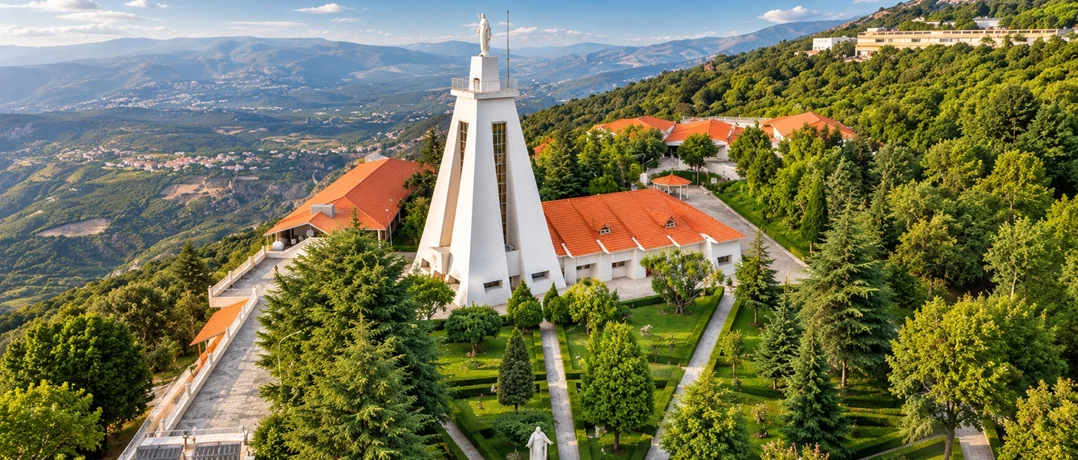
Miziara sits at 800 meters above sea level, and the name covers four settlements: Miziara, Harf Miziara, Houmeis and Sakhra. Miziara proper has about 4,250 residents, nearly 6,000 with the others included.
Miziara was uninhabited before the late 17th century, a boar-filled forest partly belonging to the Hamadeh sheikhs, who ruled Jebbet Bsharri from 1654 to 1761. Naamtallah Néhmé, ancestor of the village’s families, arrived from Bikfaya and spent roughly seventy years at a farm called Rishtaamout. His sons Younis, Abdallah, Youssef and Abdel Ahad founded the family lines, and Youssef is recorded as Miziara’s founder.
In 1761, bourgeois village sheikhs displaced the Hamadeh, and Prince Youssef al-Shihabi ruled Jebbet Bsharri directly from 1763. Miziara lost two men in the 1763 campaign, and after a 1766 land survey, tax collection was granted to the Karam sheikhs of Ehden and the Issa El Khoury sheikhs of Bsharri. The burden was concrete. Villagers, mostly sharecroppers, owed their overlords 20 kilograms of silk and 125 kilograms of tobacco yearly, plus grain and grapes. The 1849 count recorded 250 adult men in Miziara (51 households) and 163 in Houmeis (35 households).
The land question came to a head in 1913. After a court ruled for the sheikhs, Father Youssef Younis reportedly walked to Batroun and then went on to Syria to plead his case, and the land was registered to the farmers. Within a year, famine arrived. The 1915-18 Great Famine killed an estimated 100,000 to 200,000 people in Mount Lebanon, then home to about 400,000. Ottoman troops felled trees and imprisoned villagers from 1914 as reprisal for Miziara men serving under Youssef Karam, and “hundreds” disappeared. That figure explains why emigration became a village creed.
Nigeria, from 1890
West Africa historians note 1890 as the year Elias Khoury of Miziara reached Lagos, founding the Lebanese community in Nigeria, according to a 2003 University of Ilorin PhD by Peter Adebayo. Historian Devendra Misra’s 1985 thesis adds a detail, Khoury’s nephew, Nasim Younis, told him in a 1977 interview that his uncle came to Lagos from Sierra Leone. By Nigerian independence in 1960, an estimated 6,000 Lebanese lived there, including 1,500 in Lagos and 1,000 in Kano. Adebayo’s 2000-2008 fieldwork covered Miziara and its Muslim neighbor Jwaya.
The remittances rebuilt the village. More than 300 houses had gone up since 2008, and the deputy mayor said about 80 percent of the village worked in Nigeria. One house cost around $20 million, with 2,000 square meters and 30 bedrooms. The best-known family of Miziara origin is the Chagoury family.
June 16, 1957
The village’s darkest day is documented in court records. Reconstructed from Joseph Chami’s Mémorial du Liban, it began as a memorial mass for Salim Abed, with six bishops present. A gunman fired for nearly ten minutes before being shot, leaving 23 dead and 50 wounded, ten Douaihy, five Frangieh and eight other worshippers. The tension followed Father Semaan Douaihy’s candidacy for parliament, with elections two weeks away.
The army arrested over 80 suspects, and arrest warrants for 34 people on July 13 included Sleiman Frangieh, René Moawad and Douaihy. A clash in Ehden on August 2 killed four, including Lieutenant Antoine Obeid. On November 13, twenty-seven wanted men fled to Syria. On November 29, 1958, the court overturned the original indictment. Frangieh received six months for illegal weapons possession and Moawad was acquitted. The versions diverge: Frangieh claimed a Douaihy youth shot a gendarme first, while Douaihy said it was an ambush, noting his side’s dead were shot in the back. Novelist Jabbour Douaihy later said the Zgharta feuds were a “rehearsal” for the civil war that erupted in 1975. His 2006 novel June Rain reconstructs the day.
Faith and hospitality anchor the village now. Our Lady of Miziara, Mother of Mercies, a statue shrine at the village entrance, was built by native son Marcel Chaghoury in 1979 and consecrated in 1992 by Bishop Antoine Jbeir. Its entrance is guarded by limestone angels, and it includes sculpted scenes of Christ’s Baptism, the Wedding at Cana and the Last Supper. The village also has the St Elias shrines and Hotel Miziara, its first hotel. Beyond the architecture, the surrounding forest of oak, cedar and pine invites hikers, with Houmeis just across the way. Local farms still grow apples, pears and grapes.
Miziara asks a question many Lebanese villages share, what does home mean when most of its sons and daughters live abroad? Its answer is in stone, from a founder’s forest to village homes.
-
-

-
Jenna GeageaReporter/Writer
-
