



As Lebanon marks Independence Day, this article examines the Lebanese Army’s role in restoring state authority and the political and financial support it needs to defend the country.
LAF: The last pillar of Lebanon’s independence
LAF: The last pillar of Lebanon’s independence
By Michael Al Andary | November 22, 2026

Reading time: 6 min
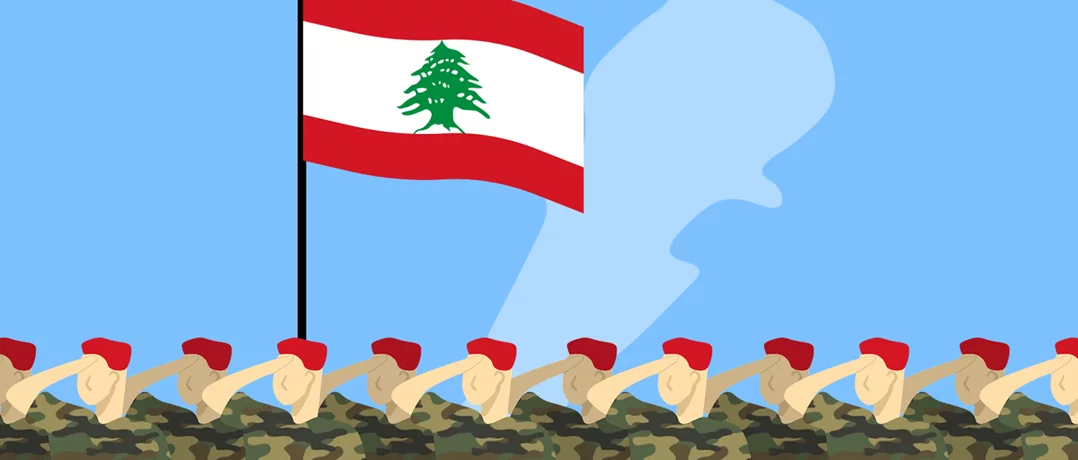
Every November 22, Lebanon commemorates the independence it achieved in 1943. Yet, 83 years later, the definition of independence remains closely tied to a question the country has struggled to answer: who ultimately controls its territory, protects its borders and makes decisions over war and peace?
At the center of that debate stands the Lebanese Armed Forces (LAF), an institution that has managed to preserve its national character despite decades of political instability, sectarian divisions and economic deterioration. Consisting of soldiers and officers from across Lebanon’s different communities, the Army remains one of the few institutions that can claim a genuinely nationwide presence and represent a shared national identity.
A security source close to the Lebanese Armed Forces, speaking to The Beiruter on condition of anonymity, described the Army as “the last hope for Lebanon's stability” amid the country’s mounting challenges. “The LAF is like a huge tree, with all Lebanese communities represented among its branches. It is one of the few institutions that continues to bring the Lebanese together, regardless of their political or sectarian affiliations,” the source said. “It is the duty of every Lebanese to stand behind one national army and support one legitimate armed force: the Lebanese Armed Forces. There should be no alternative to the authority of the state when it comes to defending the country and protecting its people.”
LAF beyond military responsibilities
LAF’s importance extends well beyond military responsibilities. In a country where political institutions have frequently been weakened by competing interests and sectarian calculations, the Army has remained a symbol of continuity and national cohesion. Its ability to maintain internal stability while carrying out security missions across the country has made it a central pillar of what remains of the Lebanese state.
But the institution’s symbolic importance has increasingly been matched by expectations that it may struggle to meet without political backing and substantial international assistance.
Sovereignty and the challenge Southern Lebanon
Nowhere is the Army’s role more consequential than in southern Lebanon, where the question of state authority has remained unresolved for decades.
Following the November 27, 2024 ceasefire between Israel and Hezbollah, the LAF began expanding its deployment south of the Litani River as part of efforts to implement United Nations Security Council Resolution 1701 and restore the authority of the Lebanese state. The objective is straightforward in principle: ensure that security decisions and the use of force fall exclusively under state institutions.
However, in practice the mission is considerably more complicated.
The persistence of Hezbollah’s independent military capabilities has long challenged the state’s ability to exercise exclusive authority over weapons and security decisions. At the same time, continued Israeli military presence in parts of Lebanese territory, airstrikes and repeated violations have obstructed the Army’s efforts to consolidate its deployment and allow displaced residents to return to their villages.
The result is a difficult position for the LAF. It is expected to extend state authority while operating in an environment where neither the question of non-state weapons nor the Israeli military presence has been resolved.
The Army’s mission is therefore not simply about deploying additional troops or establishing military positions. It is about restoring a political and security principle that lies at the heart of independence: the Lebanese state must be the sole authority responsible for defending its territory and determining matters of war and peace.
An army without the resources it needs
The expectations placed on the LAF stand in sharp contrast to the resources available to it.
Lebanon’s financial collapse, which began in October 2019, has severely affected the military institution. The collapse and depreciation of the Lebanese Lira significantly eroded soldiers’ salaries and purchasing power, while years of underfunding have affected maintenance, equipment, logistics and operational readiness.
The consequences are not merely administrative. An army cannot be expected to secure extensive borders, maintain a presence across the country, combat organized crime, monitor smuggling routes and assume additional responsibilities in the South without the personnel, equipment and financial means to do so.
The scale of the challenge has also been acknowledged internationally. A November 2026 assessment by the International Institute for Strategic Studies highlighted the Army’s funding and capability shortages, noting that it estimated it would need approximately $3 billion in external financing over five years to meet its operational requirements.
International assistance has consequently become essential. The European Union (EU) adopted a €100 million assistance package in June 2026, bringing its total support through the European Peace Facility (EPF) to €182 million. Such assistance reflects international recognition that strengthening the LAF is inseparable from strengthening Lebanon’s sovereignty.
Nevertheless, foreign support cannot replace the political decisions required from Lebanon’s own leadership. Equipment and funding can improve the Army’s capabilities, but they cannot independently resolve the political disputes that continue to limit the state’s authority.
The political burden of a national institution
Perhaps LAF’s greatest challenge is not exclusively military, but political.
Lebanon’s sectarian power-sharing system has repeatedly complicated the functioning of state institutions, often placing national interests behind the calculations of political parties and their respective constituencies. The LAF has largely managed to preserve its internal cohesion despite these pressures, an achievement that should not be taken for granted in a country with such a fragmented political landscape.
Yet, maintaining that cohesion while implementing difficult government decisions requires a delicate balance. The Army cannot operate independently of the political authorities, nor can it be expected to resolve fundamental national disputes without a clear mandate and sustained political support.
Its commander, General Rodolph Haykal, reiterated in his November 19 Independence Day order that the Army remains committed to implementing the decisions of the political authorities, completing its deployment in the South and extending state authority across Lebanese territory. He also made clear that the military institution stands at an equal distance from all political parties.
That neutrality is central to the Army’s legitimacy. Its credibility depends on being perceived as a national institution rather than an instrument of any particular political camp.
The coming departure of the United Nations Interim Force in Lebanon (UNIFIL), whose mandate is due to expire at the end of 2026 before its withdrawal throughout 2027, will add another layer of responsibility. The Army will increasingly be expected to assume security responsibilities in an environment where international arrangements and the future of border monitoring remain uncertain.
Independence requires a strong state
Lebanon’s independence cannot be measured solely by the date on which foreign rule ended. It must also be measured by the state’s ability to protect its people, secure its borders and exercise authority throughout its territory.
The Lebanese Army remains central to achieving that objective. But expecting it to carry the weight of the country’s sovereignty while leaving it underfunded, politically constrained and exposed to competing security realities would be a contradiction.
Strengthening the LAF requires more than statements of support. It demands sustained funding, modern equipment, institutional reform and, above all, a political consensus that the authority of the state must prevail over competing interests.
As Lebanon marks another Independence Day, the Army’s significance is perhaps best understood through the responsibilities it continues to shoulder despite the circumstances. It remains one of the country’s strongest expressions of national unity, but it cannot be expected to compensate indefinitely for the weaknesses of the political system.
Surely, the strength of the Lebanese Army will depend not only on the soldiers serving in its ranks, but on the willingness of Lebanon’s political leadership to give the institution the authority and resources necessary to fulfil its mission.
Independence, after all, is not simply the absence of foreign rule. It is the ability of a state to govern itself. And that remains a task Lebanon has yet to complete.
