



Graziella Sfeir and Gael Beaino reveal the creative vision, collaboration and design process behind Dancing with the Stars’ internationally acclaimed visual identity on MTV.
Inside the creative vision behind Dancing with the Stars Lebanon
Inside the creative vision behind Dancing with the Stars Lebanon
By Jenna Geagea | November 24, 2026

Reading time: 4 min
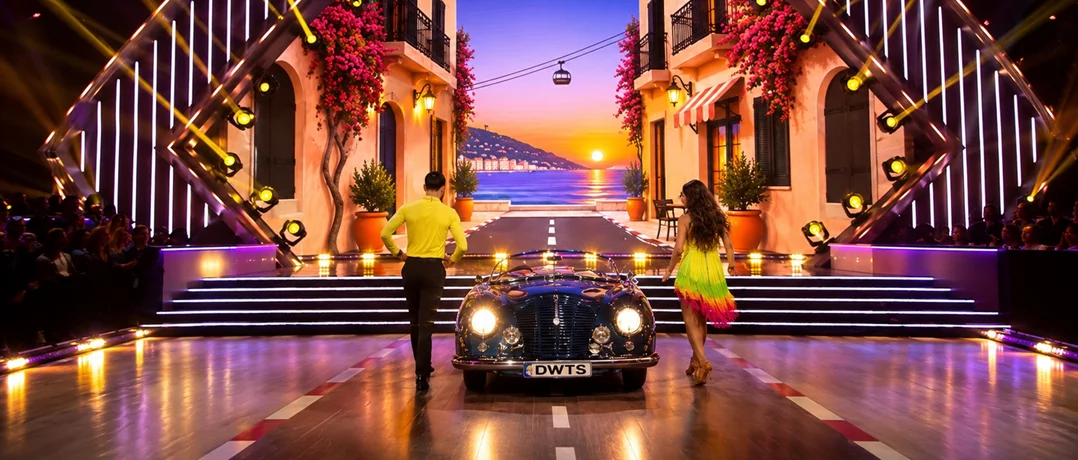
When Dancing with the Stars returned to the screen, it did so as a phenomenal regional production, filmed in Lebanon, powered by Lebanese talent, and watched across the Arab world. The result is a spectacle of genuinely international standard, one that rivals the world’s best-funded productions and showcases a creativity that has the whole country talking. Every frame, from the monumental LED worlds to the smallest prop, reflects a level of craft rarely seen on a local stage.
At the center of that creativity is Graziella Sfeir, the show’s Creative Director, whose vision is nothing short of exceptional. Beside her stands Gael Beaino, Art Director who brings a fresh eye and a designer’s discipline.
Sfeir is modest about the acclaim, though she does not dispute its source. “In Lebanon, we have so many beautiful things. We are very creative,” she told The Beiruter, pointing to Lebanese professionals whose work stops people in their tracks. This time, she explained, the pressure drove the ambition,with the show’s comeback, the bar was set ‘very high,’ and there was a determination to meet it
The guiding concept for the opening sequence, awaken the god within, treated the celebrity dancers as figures of mythic stature. The Lebanese identity of the production was woven in with restraint rather than ornament. “We thought of the Lebanese element that is part of who we are,” Sfeir recalled, “but we avoided the traditional way of doing it, dressing them in traditional clothes.” The nod to home was deliberately subtle, and the effect was distinctive.
From music to mood to motion
The creative process begins with sound. Each routine reaches the design team with the celebrity and their partner, the song, and a loose direction from the producers about where the piece should travel visually
Beaino described the team’s role as elevation. “We take it, we uplift it,” she noted. The visual language must then answer the music itself. A salsa and a paso doble demand different energies, and the animation must follow, slowing or quickening with the choreography so that the screen reflects the dance’s temperament.
Local color enters where the song allows it. A serene piece might unfold in an immaculate mountain village. An Italian number, naturally, receives no such treatment.
The LED backdrop does not operate alone. The art director responsible for props, coordinates with the design team so that physical and digital elements read as one composition.
“You feel it is genuinely part of the LED, not one design on the side and something else moving behind it,” she explained. The aim, she added, is for everyone to work so closely that the result becomes “one tableau.”
Validation happens in the studio. Before each prime, Sfeir, Beaino and the producer test the LED visuals on location, judging scale and color against the original idea. Once the concept is approved as an LED design, Beaino adapts a portion of it for the floor, extending the world of the screen across the stage.
Between trends and identity
Both directors are candid that a show of this kind cannot ignore trends, and equally firm that it cannot be led by them. Sfeir observed that creative people absorb influences almost unconsciously, drawing on everything they encounter: the cities she travels to, the theater she attends, the cinema she watches, the art she sees along the way. “Everyone has their own style,” she maintained. “I am influenced by trends, but my identity remains the same.”
The generational gap between her and Beaino, close to the distance between a mother and daughter, proves an asset. “I always love that fresh look,” Sfeir confided. When she presents an idea and Beaino counters with another direction, she reads it as a cue that something new is needed. “That freshness is what adds the zest.”
Beaino is wary of imitation. She laments that many self-proclaimed designers chase whatever appeared yesterday, packing every learned tool into a single project. Experience teaches restraint, absorb what is striking, but do not use everything. The channel’s identity and the show’s standing supply the frame. Even her own taste for the surreal bends to the scene. “Sometimes you have to abide by the style of the scene,” she conceded.
On artificial intelligence, she is measured. It is a tool for artists. Without craft, however, novelty fades quickly. “You will enjoy it for the first ten days, and then it just looks generated,” she cautioned.
Sfeir condensed their method into a formula: “a mix of inspiration, quality and experience.”
Asked whether competing with international productions on a smaller budget has produced frustrations, Sfeir redirected the question. Money was not the obstacle. The scarce resource is time. “Many times we do not need more money; we need more time, and we do not have it.”
Beaino agreed that the available tools are strong, and added that the team habitually compensates for constraints. When an international tool promises to speed up the work, they find a way to adopt it. Given more hours, the ceiling would rise further.
The coming episodes promise more narrative range. Until now, Sfeir told The Beiruter that, until now, most routines have unfolded within a single scene. The team intends to build toward two or three scenes per routine. With fourteen routines in an episode, the workload multiplies accordingly. Not every dance subject will allow it, but the ambition is set.
Challenge is where Sfeir’s instinct has always led. Not every dance will allow such treatment. But for a Creative Director who has already placed a Lebanese production beside the world’s best, realism has never meant restraint. The next step is simply to higher the bar even further. “More work, yes,” she reflected. “But we will do it!”
-
-

-
Jenna GeageaReporter/Writer
-
