

From financial aid to military equipment and training, countries across the world are supporting the Lebanese Army.
Lebanon’s Army and its international backers
Lebanon’s Army and its international backers
By Natalie Durham | November 27, 2026

Reading time : 6 min
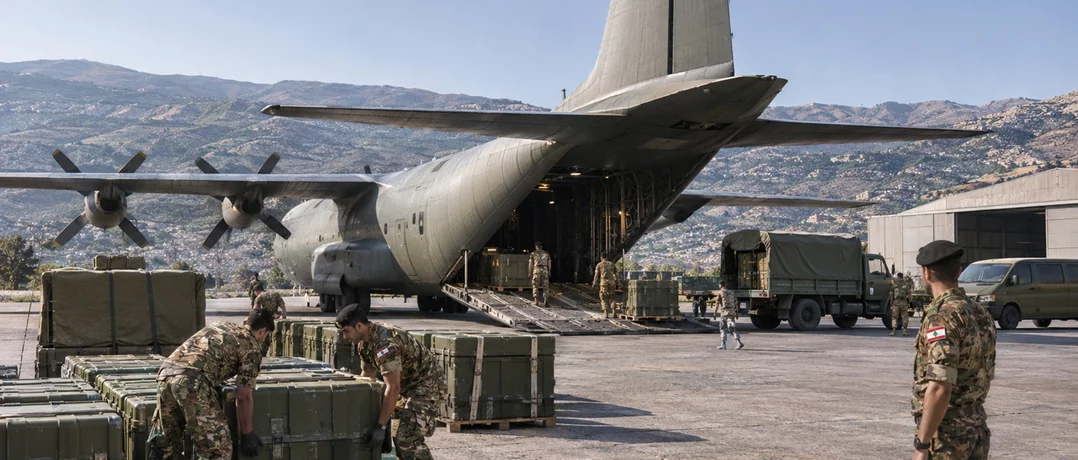
Over the past 20 years, billions of dollars in international assistance have been directed towards the Lebanese Army. From military vehicles, equipment and border observation posts to training and capacity-building programs, monthly salary grants and medical supplies, countries across the world have contributed to strengthening the army and supporting its soldiers.
Today, as the Lebanese Armed Forces (LAF) expand their presence along the Lebanese-Syrian border, in southern Lebanon and across the country, these partnerships continue to grow. While the nature and scale of assistance vary from one country to another, much of this support shares a common objective: strengthening the army’s capabilities and reinforcing Lebanese state authority.
The United States and Britain
The United States remains one of the Lebanese Army’s largest military supporters. Since 2006, Washington has provided more than $3 billion in security assistance, including $190 million to the Lebanese Army over the past year. American support aims to strengthen the army’s capabilities, secure Lebanon’s borders and reinforce the state’s exclusive authority over weapons.
American assistance has continued throughout 2026. On September 29, the Lebanese Army received 47 Humvees and five trucks at the Port of Beirut under existing US military assistance programmes. According to the Army Command, the delivery was intended to improve the readiness of military units and their ability to carry out operations.
The US Congress has also made $50 million available for assistance to the Lebanese Army under its 2026 appropriations legislation. The funding, available until September 30, 2027, covers training, equipment, supplies, stipends and infrastructure repairs.
Britain, meanwhile, has focused much of its assistance on Lebanon’s border security. On November 26, 2026, the British Embassy announced the handover of a newly completed border observation post in Ain Al Mzreb, West Bekaa. British assistance has supported the construction of 85 border towers and military bases along the Lebanese-Syrian border, in addition to helping establish the Land Border Regiments. The programme aims to reduce smuggling, protect local communities and strengthen state control over the border.
Since 2009, Britain has committed more than £120 million to the Lebanese Army through training, equipment and capacity-building programmes. In August 2026, London also signed an agreement with Lebanon for a 31-month security assistance programme worth up to £16.3 million. The programme covers both the Lebanese Army and the Internal Security Forces.
Arab support: From salaries to military equipment
Not all international assistance comes in the form of military equipment. Qatar has been among the countries helping Lebanese soldiers cope with the financial consequences of the economic crisis.
In June 2022, Doha announced a $60 million donation to support the Lebanese Army. The first instalment was received in August 2022, followed by several payments, with the sixth instalment arriving in March 2023 providing soldiers with monthly financial assistance of $100. Qatar had also previously provided monthly food assistance to the military institution. Qatar's support has also helped cover the army's daily expenses. In July 2024, the military institution received $20 million in financial assistance, followed by a $15 million fuel donation announced in September of the same year.
During President Joseph Aoun’s visit to Doha in April 2025, Qatar renewed its $60 million salary grant and pledged an additional donation of 162 military vehicles. On January 29, 2026, the Lebanese Army officially received the first 37 vehicles through the Qatar Fund for Development.
Saudi Arabia has also expressed its willingness to support the Lebanese Army. The Kingdom previously pledged $3 billion to equip the army with French military equipment, but suspended the programme in 2016. More recently, Saudi Arabia has participated alongside France, Egypt, Qatar and the United States in preparations for an international conference supporting Lebanon’s security institutions.
Jordan has also played a role in supporting the Lebanese Army. On January 29, 2026, the LAF received a Jordanian food donation. On September 17, 2026, King Abdullah II participated alongside President Joseph Aoun and French President Emmanuel Macron in a meeting in Paris to discuss international assistance and Lebanon’s growing security responsibilities.
Europe and beyond
Since 2022, the European Union has approved €182 million in assistance to the Lebanese Army through the European Peace Facility. This includes four funding packages: €6 million in December 2022, €16 million in September 2024, €60 million in January 2025 and €100 million in June 2026. The latest package covers border and maritime security, military healthcare, training and the protection of military facilities.
Some of this assistance has already reached Lebanon. In June 2026, the EU confirmed the delivery of nearly 50 specialized vehicles and pieces of engineering equipment. These included cranes and machinery used for construction, logistics and recovery operations.
Individual European countries are also supporting the Lebanese Army. On October 9, 2026, France delivered a shipment of ammunition to the army at the Port of Beirut, as part of ongoing military cooperation between the two countries.
Italy has focused part of its assistance on military healthcare, donating 30 tonnes of medical equipment and supplies in September 2025, followed by advanced equipment for treating heart diseases at the Central Military Hospital on October 13, 2026.
In April 2026, the Netherlands announced a €13.5 million aid package for Lebanon, of which €7 million was allocated to the Lebanese Army to help extend state authority across the country. This followed approximately €7.5 million in Dutch military assistance announced in November 2025. The Netherlands has also provided medical equipment to hospitals in southern Lebanon through its cooperation with the army’s Civil-Military Cooperation Directorate (CIMIC).
Germany and Norway are also helping improve the living conditions of Lebanese soldiers and their families. On October 8, 2026, Germany announced an additional €5 million in assistance through the United Nations Development Programme (UNDP), bringing its total contribution to the programme to €10 million. Norway announced an additional $1.5 million in August 2026, after allocating 30 million Norwegian kroner in December 2024.
Greece has also contributed to strengthening the army's military capabilities. On January 24, 2025, Cyprus delivered 33 tonnes of supplies and support equipment to the Lebanese Army in cooperation with France, which provided transportation. In January and August 2026, Athens delivered a total of 46 military vehicles, including 26 armoured personnel carriers and 20 trucks, along with spare parts. Both shipments have already reached Lebanon.
The solar power system provides a more reliable electricity supply at the checkpoint, while improved lighting helps soldiers carry out their duties at night, particularly given Lebanon’s ongoing electricity crisis.
On October 21, 2026, the Spanish Defence Staff confirmed the installation of a solar power system and the rehabilitation of lighting at a checkpoint in southern Lebanon, helping improve working conditions for Lebanese soldiers and support their daily operations.
Beyond Europe, Canada has allocated CAD $30 million to support the Lebanese Army since 2016 and provided training to more than 2,500 Lebanese military personnel. In February 2026, three military warehouses renovated with Canadian funding were handed over to the army. Japan has also contributed to military healthcare through a project funded by the Japanese government and implemented by UNOPS. The project included renewable energy systems for the Shoukri Ghanem Medical Dispensary and the Ministry of Defence Medical Dispensary, as well as medical equipment for the intensive care unit at the Ein Ebel Military Hospital in Nabatieh. More recently, on November 24, 2026, Japan handed over two ambulances to strengthen the army’s emergency response capabilities.Türkiye has pledged 100 million Turkish liras in support of the Lebanese Army, an agreement approved by Lebanon’s parliamentary Finance and Budget Committee on September 14. China has also contributed to supporting the Lebanese Army.
From the soldier on the border to the doctor in a military hospital, international assistance reaches far beyond weapons and ammunition. Each country is contributing in its own way to keeping the Lebanese Army operational.
-
-

-
Natalie DurhamResearcher/Writer
Junior research writer focusing on politics, public policy and international affairs.
-
