



From a spontaneous idea to a waterfront gathering of nearly 100 women, LYORA World’s first “Girls Walk” in Lebanon turned movement into connection and strangers into something closer.
Girls walk: Rewriting the rules of showing up

“It’s all happening…” read the caption floating above a hand-held sign that said it louder: Hot Girls Walk. Outside a glass-front café in Dbayeh, two women grin into the moment, arms raised, the kind of image that usually lives and dies on Instagram. This one didn’t. It spilled into real life.
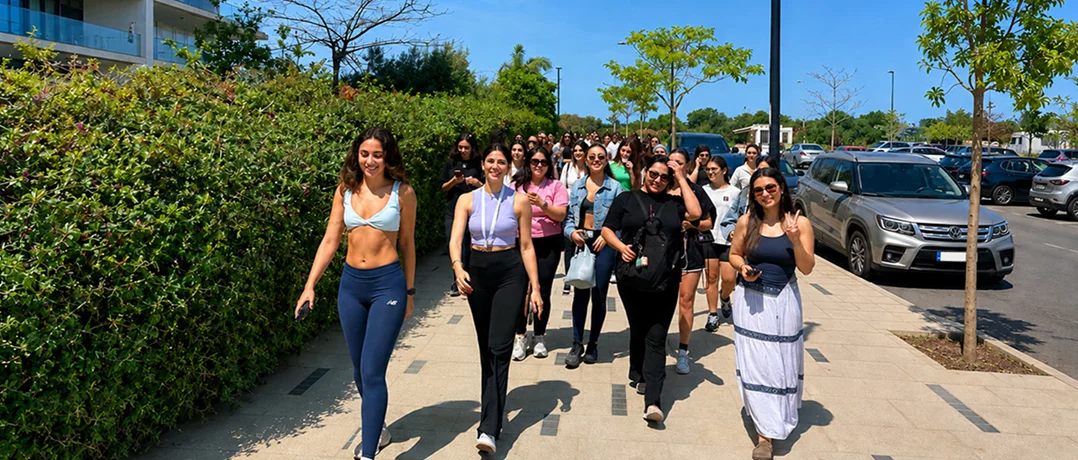
Last Saturday morning, the waterfront filled with women arriving alone, in pairs, in small clusters; some hesitant, others already laughing. By the time the walk began, the number had climbed far past expectations. “I expected like 20, 30 people to register,” says Grace Hasrouny. “Now we have over 70 people registered already.”
Grace, 25, a digital media graduate and self-described creator of “moments and experiences,” had been working toward this for a year. Building a women’s community through her platform, LYORA World, came from a personal need as much as a social one. “As someone who is very growth-oriented, I struggled with this idea,” she says, searching for a connection that felt intentional.
This walk, as Grace describes it: “It’s not as random as you think it is.”
From Dubai to Dbayeh
The idea took shape months earlier, in a different city. In Dubai, Grace collaborated with a walk club called Club After Six, testing the concept in a place where community-building events are part of the rhythm. The idea stayed with her. “After the good feedback, we decided that we need to do it again in Lebanon.”
The original plan had a date: March 8, International Women’s Day.
The day that we wanted to announce it, the war started. So we canceled everything and we just paused.
Weeks passed, then something shifted. “This week, I felt like, okay, now I think it’s time to just get back on it.” The planning moved fast. Messages went out, a collaboration secured with a waterfront café “Piccolo me”, a route imagined. Grace calls it spontaneous, though the groundwork had been quietly building for months.
When the post went live, it spread. “I did not expect at all for the post to go viral. I was just randomly sharing.” Her inbox filled. “Honestly, my DMs are flooded.”
Walking, then staying
The concept sounds simple: a walk followed by coffee. In practice, it’s more deliberate. Movement draws people in; conversation keeps them there.
“We wanted to do something like movement,” Grace explains. “And we wanted to have some networking time and not just do the walk and leave.” After the walk, the women returned to the café. Some ordered drinks and some stayed to talk with each other, while many women were meeting each other for the first time.
Icebreakers helped dissolve the first layer of awkwardness; the goal was never fitness.
It’s not a walk club. The purpose is not to create a walk club. It’s to create a valuable event for like-minded women to connect.
In a country where social events often orbit around existing circles, this one leaned into the unfamiliar. Showing up alone and starting somewhere.
Showing up alone
There’s a particular courage in arriving without a buffer. Grace knew that and she designed around it. “I want every woman that comes to feel like, okay, it was the right choice I made to come here today even though I came alone.”
By the end, that intention had taken shape in small, visible ways. Women introducing themselves without hesitation, conversations stretching beyond polite exchanges and laughter landing easily.
“I did not feel lonely,” one participant mentioned. “I felt like I was surrounded by so many people that align with me… or that I was able to have good conversations with.”
The simplicity of that aim lands differently in Lebanon, where public space can feel fragmented. Gathering as women, in daylight, with no agenda beyond connection, carries its own quiet defiance.
“There’s a big gap in Lebanon,” Grace says. “We have a lot of clubs and there’s a lot of networking events… none of them are women curated.”
What began as a “chill” comeback after months of uncertainty turned into something more urgent. “Apparently, everyone needed that.”
Grace sees this as part of a larger direction. “The bigger picture is creating more valuable events. To be able to really inspire women in different ways.”
The first walk ended where it began: by the water, near the café, in a loose circle that slowly broke into smaller ones. Plans were already forming, exchanged between sips of coffee and numbers typed into phones.
Grace is already thinking ahead. Another edition, likely in Beirut. Maybe monthly. The structure will evolve. The core idea stays intact. “I really hope that women will be more courageous to join such events,” she says. “And not be shy or afraid to come alone. To really feel like it’s a safe space.”
-
-

-
Rayanne TawilCultural writer
-
