



Lebanon welcomes Pope Leo XIV as a symbol of peace, reconciliation, and national resilience today.
Lebanon welcomes Pope Leo XIV: A message of peace amid storms and a deepening crisis
Lebanon welcomes Pope Leo XIV: A message of peace amid storms and a deepening crisis
By Josiane Hajj Moussa | December 01, 2025

Reading time: 4 min
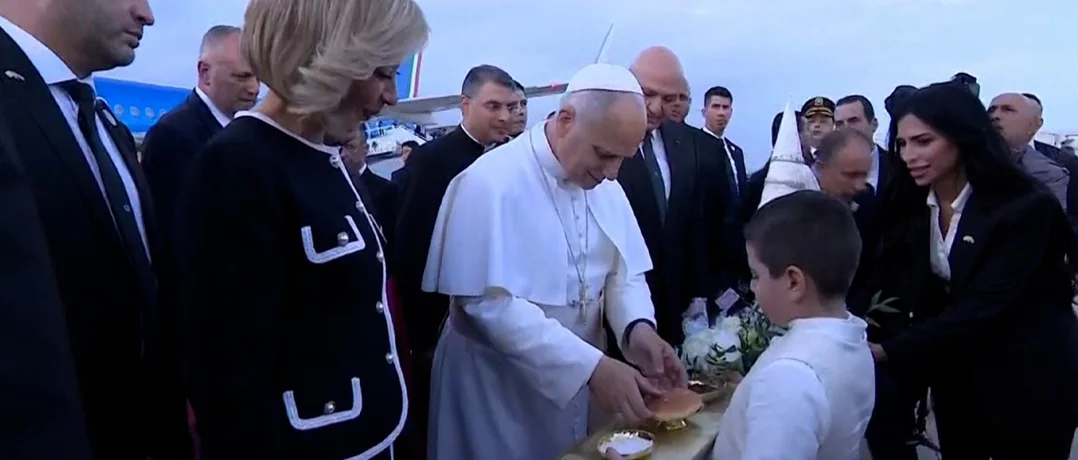
Twenty-one cannon shots fired by the Lebanese Army, church bells ringing, and ships docked at the Port of Beirut sounding their horns all to welcome the arrival of Pope Leo XIV to Beirut. The visit, described as historic, comes at an extremely sensitive moment for the country; after years of financial collapse, political deadlock, escalating security challenges, and fears of a looming Israeli war, this visit is seen as a lifeline, even if it fulfils a promise originally made years ago by the late Pope Francis. Lebanon awaited this visit with hope and anticipation. Lebanon is the second stop after Turkey on Pope Leo XIV’s first official international tour.
At Beirut International Airport, President Joseph Aoun was the first to receive His Holiness, followed by Speaker of Parliament Nabih Berri and Prime Minister Nawaf Salam. The official reception unfolded to the Lebanese and Vatican national anthems before the papal convoy moved forward under tight security measures, including army deployments along the route and a helicopter flying over the convoy. Crowds also gathered on the Airport Bridge in Beirut’s southern suburbs and at the entrance of the Presidential Palace in Baabda to welcome the Pope with cedar branches, flowers, and ululations despite the bad weather.
At the palace entrance, the Pope entered in his popemobile to the sound of drums and Lebanese dabke. A short video was shown highlighting the theme of peace, ending with the release of a white dove. The President and First Lady received the Pope at the palace door, as the President’s grandchildren presented His Holiness with a bouquet of white flowers and olive branches.
Inside the palace, the Pope held consecutive closed-door meetings with the three presidents, along with an exchange of gifts and commemorative photos, while political, diplomatic, religious, and civil society figures continued arriving to greet the Holy Father and listen to his address.
Addressing nearly 400 people at the Presidential Palace, President Joseph Aoun affirmed that the Pope’s visit is not merely a protocol event but “a historic moment that reaffirms that Lebanon despite its wounds and the storms of recent years remains in the heart of the Church and the conscience of the world.” He described Lebanon as “a space of freedom, a land of encounter, and a human message spanning generation.”
He emphasized that the reception of the Pope was not in the name of any single group or sect but in the name of all Lebanese, saying, “Lebanon with all its components: Christians and Muslims, sects and denominations welcome Your Holiness with joy and a rare moment of national unity in a time of division.” He saw the visit as further evidence of the Vatican’s confidence in “Lebanon’s uniqueness and its mission in the East.”
Speaking about Lebanon’s historic and civilizational role, Aoun said the country “remains, despite its ordeal, a bridge between East and West, a platform for dialogue among religions and cultures, and an oasis of freedom and religious plurality in a turbulent region.” In a highly symbolic tone, he added:
Tell the world about us that we will not die, we will not leave, we will not despair, and we will not surrender. We will remain here, breathing freedom, inventing joy, and mastering love.
Aoun concluded by expressing “deep gratitude” for the Pope’s acceptance of the invitation, saying the visit will serve as “a spiritual and national milestone” that restores to Lebanon a measure of confidence and hope and offers, at a critical moment in its history, a moral push toward stability and reclaiming its place and role.
Pope Leo XIV’s address: Blessed are the Peacemakers
The Pope opened his speech with “Blessed are the peacemakers,” stressing that peace is not a slogan but a responsibility requiring clear and continuous decisions from both the state and society. He added that Lebanon’s current circumstances are not unique in the world, but dealing with them must be guided by constructive thinking rather than reactive responses.
He spoke about the Lebanese experience, saying that religious plurality is not a problem but a reality that must be managed with political and institutional awareness, noting that no system in a diverse country can remain stable if it relies on domination or exclusion. He called for adopting a shared discourse instead of continuing parallel or clashing narratives.
The Pope outlined reconciliation as a basic requirement for state-building, explaining that addressing past mistakes cannot occur through denial or repetition but through acknowledgment, organization, and rebuilding trust among components. He said lasting peace requires agreement on one national goal, not merely temporary understandings.
He addressed migration, saying it stems from the absence of stability and job opportunities, noting that the solution is not to stop migration but to create conditions that make staying a realistic choice rather than a risk. He also noted the role of the Lebanese diaspora, describing them as part of Lebanon’s political and social fabric, not merely an external extension.
On society, the Pope emphasized the role of youth and women in any reform process, saying that ignoring them means postponing solutions rather than forming them. He saw inclusive participation in political and administrative decision-making as a necessity, not a privilege.
He concluded with a practical message, saying peace is neither an idea nor a text but a daily practice in governance, administration, and relationships among groups, affirming that Lebanon can overcome its crisis if it adopts a realistic approach that goes beyond old conflicts toward a new, applicable national agreement rather than one meant for political consumption.
A visit loaded with political meaning
Lebanese official circles view the visit as a historic event welcomed widely because it brings messages of moral support and hope to a small country facing one of the most complex phases in its history. The visit comes amid escalating regional tensions and rising fears in Lebanon of expanded Israeli attacks, giving the Pope’s presence and messages additional weight.
So far, the visit appears far more than a protocol stop or ceremonial event. From Nicaea to Istanbul to Beirut, the Pope’s tour reflects a vision aiming to revive the language of dialogue among all parties.
Yet the key question remains: To what extent can Pope Leo XIV armed with moral influence and quiet diplomacy translate this visit into an actual political step? Will it remain a symbolic moment in Lebanon’s memory, or will it become an opportunity to open new channels of communication and push the international community toward a different approach to the Lebanese file?
-
-
-
Josiane Hajj MoussaReporter
-
