



Lebanon’s traditional bakeries are living repositories of family, memory, craftsmanship and a slower way of life.
The soul of the Lebanese bakery

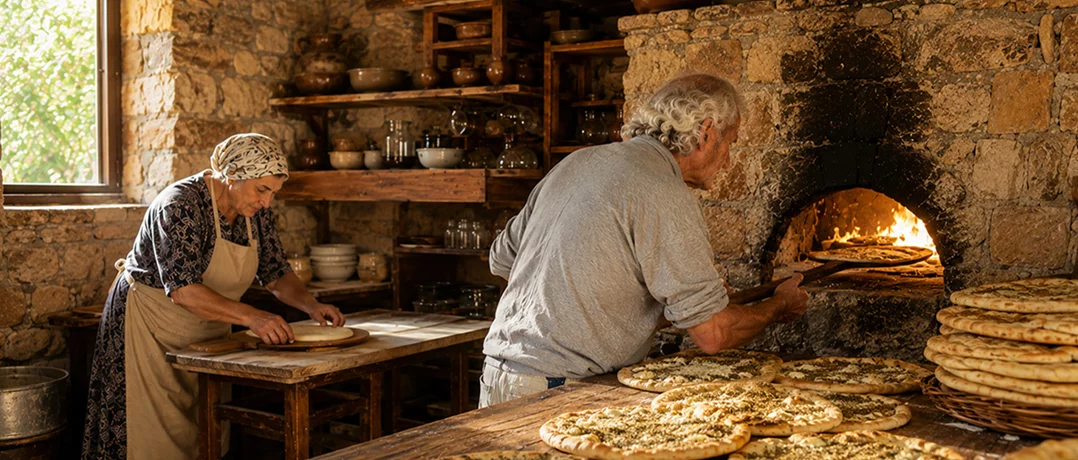
A Lebanese bakery is a fixture of the village morning, a meeting point disguised as a shopfront, and, for many families, the closest thing to an inheritance that is not written down. The Lebanese furn, the word itself borrowed from the Arabic for oven, occupies a singular place in the country's culture, part kitchen, part town square, part archive of a slower way of life that modern Lebanon has only partially left behind.
The art of the furn
The bakery’s centrality to Lebanese life is baked into the language of the food it produces. The word manakish derives from the Arabic verb "to carve or engrave," a reference to the fingertip indentations pressed into dough before it takes its toppings, a small, deliberate gesture repeated millions of times across the country every morning. For centuries, families would prepare their dough at home at dawn and carry it to the communal oven, where za'atar, cheese, or kishk would be layered on before the bread met the fire. That ritual made the manoushe as much a social institution as a meal, typically eaten in the early hours and often prepared in batches large enough to share.
What distinguishes the traditional furn from anything resembling a modern bakery is its intimacy with fire. Old ovens are said to have their own temperament, hotter in one corner, gentler in another, and a good baker learns to read that unevenness. The dough shifts with the seasons, the heat, even the humidity of a given morning, and the baker's hands decide when it is ready.
This is also, unmistakably, a family trade. Village bakeries are rarely staffed by employees, they are run by couples, siblings, or parents and children working the same counter for decades, which is precisely what gives them their homey, unhurried character. Customers are recognized, asked after, folded into the rhythm of a place that remembers them. It is this warmth, as much as the bread itself, that keeps people returning to ovens their grandparents once visited.
Krikor Bakery, Baskinta: "The secret is patience"
In Baskinta, Krikor Artin Aroyan and his wife have spent 60 years tending an oven that has become an iconic stop in the village. A Lebanese Armenian proud of both identities, Krikor describes the bakery as a devotion. "It was a hobby, just like you have your own interests," he told The Beiruter of his beginnings. "I loved the idea of a bakery, and I wanted to work with bread, with God’s blessing.”
His family, he recalled, initially resisted the idea. "My family opposed me at first, but eventually they saw that there was no stopping me and they agreed." He built the business alone before marrying his wife, who joined him at the oven and, over time, became just as recognized a face of the bakery as he is. Today the two of them still run everything themselves. "Nobody helps us. We don't have employees. It's just my wife and me," Krikor said. "We make the food with our own hands."
Their menu is vast for so small an operation, roughly 95 items by his count, savory and sweet alike, all built on dough. Visitors and reviewers single out the awarma-and-egg manakish and the soujouk with cheese as standouts, alongside the classic za'atar and jebneh varieties that anchor any respectable furn.
Throughout the long years, Krikor insists the trajectory has only gone one way. "The customers don't decrease. They increase every day," he said. "People come from near and far, from outside Lebanon, from Western countries, from Arab countries." When pressed for the secret behind such longevity, his answer is deeply simple, "the secret is patience. We never went backward or turned left and right. We kept moving straight ahead."
Aida, Ayoun Orghosh: "The Oven Is Still the Oven"
At the country's highest reaches, in Ayoun Orghosh, Aida, an elderly baker has spent more than sixty years beside a single oven, a span of time she measures in relationships. "I have spent more years beside this oven than away from it," she said. She learned the trade the way most village women once did, by watching.
"Nobody sat you down and gave you a recipe with exact measurements," she recalled of her mother's instruction. "She would say, 'Enough.' And you were supposed to know what 'enough' meant."For her, the difference between industrial bread and hers lies entirely in the fire. "You can have the best flour in the world, but if you do not know your oven, you will not make good bread," she explained. "Our ovens have a personality."
Her days begin before the village wakes, dough first, then the oven, and she described childhood customers, coins in hand, who now return as grandparents, sometimes with their own grandchildren in tow. "I remember eating this when I was a child," people tell her, decades later. "This is why I continue," she said.
For Aida who never married, the bakery is her life. “People see a small bakery. I see my whole world."
The love within the Lebanese bakery
A bakery is a beautiful act of Lebanese memory. Krikor and his wife, and Aida, describe near-identical devotions to patience, to hands that know dough better than any recipe could teach them. As supermarkets and industrial bakeries spread across the country, these furns endure precisely because they offer what machines cannot, continuity, recognition, and the particular warmth of bread made by people who pour their hearts into it. As long as there are hands willing to knead and ovens willing to hold their heat, the tradition is in no danger of disappearing.
-
-

-
Jenna GeageaReporter/Writer
-
